The Nissan Xterra asks one tire to do three jobs: silent highway commuting, rutted forest-service roads, and whatever the plow leaves behind. After evaluating 5 tires against real Xterra fitments in 265/70R16, 265/75R16, and 265/65R17, we ranked them on the trade-offs owners actually feel.
Our shortlist draws on Amazon review volume, long-term owner threads on Xterra forums and r/XTerra, and off-road community durability reports — with attention to road-force balancing complaints, sidewall cuts on sharp rock, and how each tread holds up under a heavy body-on-frame SUV.
The Falken Wildpeak AT3W is the best all-round tire for a daily-driven Xterra — quiet on pavement, 3PMSF-rated for severe snow, and backed by a 55,000-mile warranty. If your Xterra airs down and crawls rock ledges, the BFGoodrich All-Terrain T/A KO2 and its CoreGard sidewall rubber is the safer bet. Budget buyers who still need certified winter traction should take the Cooper Discoverer AT3 4S.
Best Nissan Xterra Tires — Compared
Every tire below is available in at least one factory Xterra size and carries load capacity for a body-on-frame SUV.
| # | Product | Speed Rating | Type | Best For | Score | |
|---|---|---|---|---|---|---|
| 1 | Falken Wildpeak AT3W Editor’s Choice | S | All-Terrain (3PMSF) | Mixed daily + trail use | 4.6 | See Latest Price |
| 2 | BFGoodrich All-Terrain T/A KO2 Top Pick | S | Rugged All-Terrain (3PMSF) | Rock and sidewall abuse | 4.7 | See Latest Price |
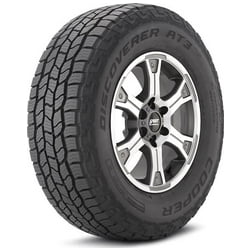
| 3 | Cooper Discoverer AT3 4S Budget Pick | T | All-Weather All-Terrain (3PMSF) | Snow traction on a budget | 4.5 | See Latest Price |
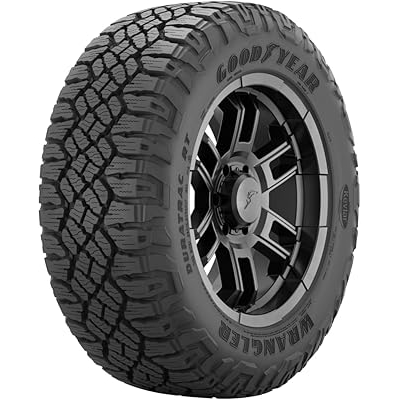
| 4 | Goodyear Wrangler DuraTrac | S | Aggressive All-Terrain (3PMSF) | Mud, ruts, deep snow | 4.5 | See Latest Price |
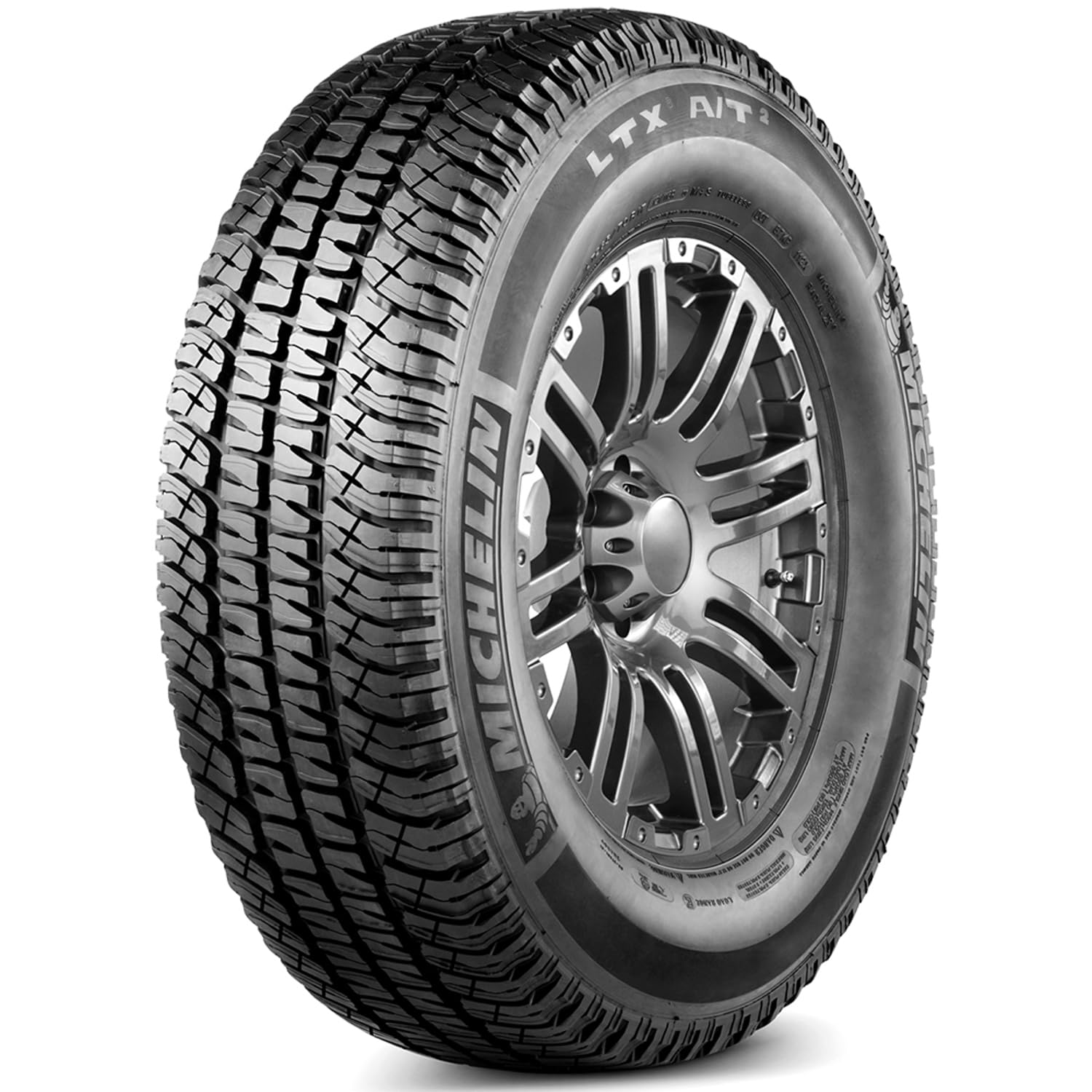
| 5 | Michelin LTX A/T2 | T | Highway All-Terrain | Quiet pavement miles | 4.6 | See Latest Price |
Detailed Reviews
Full breakdown of each tire — ratings, pros, cons, and our expert verdict.
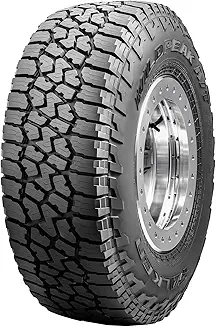
Falken Wildpeak AT3W
The Wildpeak AT3W is the tire that made “all-weather all-terrain” a real category rather than marketing language. It wears the Three-Peak Mountain Snowflake symbol, meaning it passed a severe snow traction test that most all-terrains skip entirely — so an Xterra shod in AT3Ws does not need a second winter set stacked in the garage. Falken’s silica-enriched compound stays pliable when the mercury drops below freezing, which is exactly where conventional all-terrain rubber turns hard and starts skating.
What makes it work on an Xterra specifically is the balance. The internal construction and stepped tread blocks keep highway noise closer to a highway tire than a knobby, so the 4.0-litre VQ40 at 70 mph is still the loudest thing in the cabin. Off pavement, the aggressive upper sidewall and offset shoulder blocks bite in loose dirt and give a little extra protection when the trail narrows. The 55,000-mile treadwear warranty is unusually strong for a tread this open, and owner threads regularly report even wear past 40,000 miles with a disciplined rotation schedule. The honest limitation: in genuinely deep mud, a dedicated mud-terrain still walks away from it.
- 3PMSF certified for severe snow service
- 55,000-mile treadwear warranty
- Silica-enriched compound holds wet grip in cold
- Step-down tread blocks resist stone retention
- Offered in LT-metric load ranges for loaded Xterras
- Often needs road-force balancing, not static
- Deep mud clears slower than a mud-terrain
- Heavier than the outgoing highway tire, adds unsprung mass
- Sidewall is less armored than the KO2 on sharp rock
- Popular sizes go out of stock during first snowfall
BFGoodrich All-Terrain T/A KO2
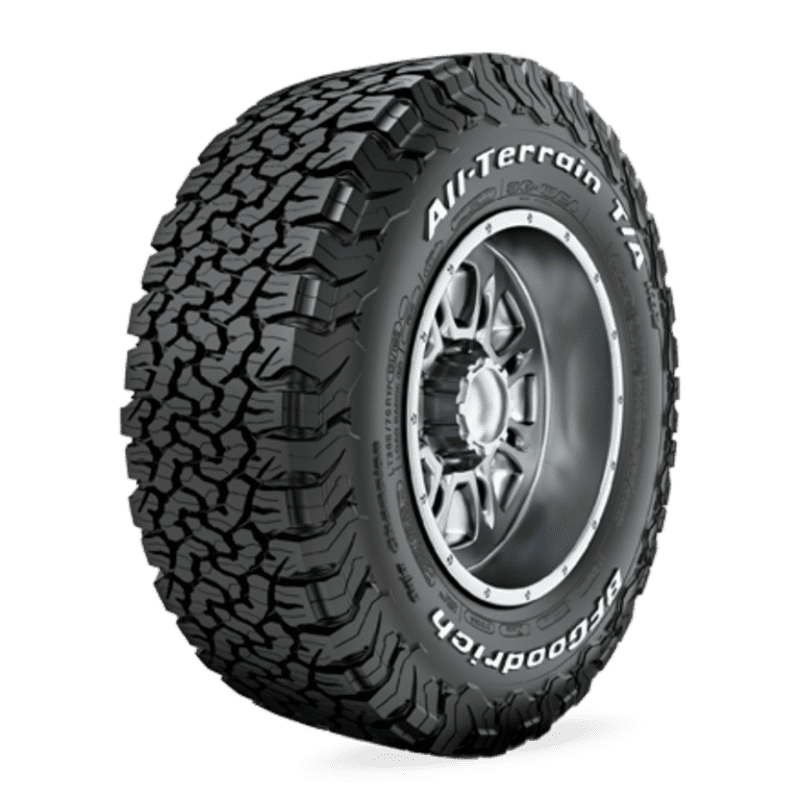
The KO2 earned its reputation in one specific way: the sidewall. BFGoodrich extends its CoreGard rubber compound — derived from the brand’s Baja race tires — up the shoulder and around the sidewall, then adds a thicker, split-and-bruise-resistant layer with a raised protective ridge. On an aired-down Xterra picking a line through granite ledges, that is the difference between a scarred tire and a walk out. Owner threads across off-road forums repeat the same story: pinch flats and gashes that end other all-terrains simply do not end a KO2.
It is not a one-trick tire. The interlocking tread blocks give it real stability on loose dirt, the mud-phobic bars eject packed clay and stone, and it carries the 3PMSF symbol, so it is legally and functionally a severe-snow tire. The trade-off is the one every KO2 buyer accepts: it is noticeably louder on pavement than the Falken, wet asphalt grip is merely competent rather than sharp, and it costs the most per tire on this list. For an Xterra that lives on the highway, that is a bad deal. For one that lives on rock, it is the only sensible answer.
- CoreGard sidewall rubber resists cuts and bruising
- 3PMSF certified despite the aggressive tread
- 50,000-mile treadwear warranty
- Mud-phobic bars eject packed clay and stone
- Available in Load Range C and E for heavy builds
- Highest price per tire in this comparison
- Audible tread hum from roughly 45 mph upward
- Wet-asphalt braking trails the Michelin and Falken
- LT casings are heavy and blunt Xterra throttle response
- Stiff sidewall rides firm at full street pressure
Cooper Discoverer AT3 4S
The AT3 4S is the tire that makes the “buy cheap, buy twice” warning fall apart. It is genuinely inexpensive, and it still carries the Three-Peak Mountain Snowflake symbol — meaning Cooper did not save money by cutting the winter capability that Xterra owners in snow states actually need. The tread uses alternating saw-tooth edges and deep siping to generate biting edges in packed snow and on loose gravel, and the silica-infused compound keeps the rubber flexible when overnight temperatures fall well below freezing.
Cooper backs the T-rated sizes with a 65,000-mile treadwear warranty, the longest promise in this group, and owner reports of 50,000-plus real miles are common on a rotation schedule. Stone-ejector ribs keep gravel from drilling into the tread base, which matters on the washboard county roads an Xterra tends to live on. Where it gives ground is refinement: a low hum surfaces on smooth asphalt at highway speed, and wet braking is a shade longer than the premium tires here. Neither is dangerous — both are simply the cost of the price tag.
- Lowest cost per tire of the five reviewed
- 65,000-mile treadwear warranty on T-rated sizes
- 3PMSF certified for severe snow
- Saw-tooth tread edges add bite on loose gravel
- Stone-ejector ribs prevent gravel drilling
- Audible hum on smooth asphalt above 60 mph
- Wet stopping distance trails the Michelin noticeably
- Fewer LT load ranges than the KO2 or DuraTrac
- Sidewall protection is basic on sharp rock
- 265/65R17 availability is inconsistent
Goodyear Wrangler DuraTrac
The DuraTrac sits at the aggressive end of the all-terrain spectrum, close enough to a mud-terrain that it borrows the same self-cleaning logic. Open shoulder lugs fling mud and slush clear instead of packing solid, and the high-void tread digs rather than floats when the surface turns to soup. Goodyear also fits a rim protector ridge that shields the wheel lip from trail rash — a small detail that matters if your Xterra wears alloys instead of steel.
It is 3PMSF-rated and, uniquely in this group, accepts optional metal studs in most sizes, which makes it the best choice for owners facing genuine ice. The tread compound resists chipping on sharp gravel, so washboard forest roads do not tear chunks out of the blocks. The honest costs: pavement noise becomes prominent above roughly 50 mph, and hard off-road use wears the DuraTrac faster than a milder all-terrain would wear. LT Load Range E sizes also add real weight, which a heavily loaded Xterra will feel at the fuel pump.
- Self-cleaning shoulder lugs clear mud and slush
- Accepts optional metal studs in most sizes
- 3PMSF certified for severe snow service
- Chip-resistant compound survives sharp gravel
- Rim protector ridge guards alloy wheel lips
- Tread roar becomes prominent above 50 mph
- Wears faster than milder all-terrains under trail use
- Load Range E casings are heavy and hurt fuel economy
- Treadwear warranty varies by size, shorter on LT
- Open tread throws more road spray in rain
Michelin LTX A/T2
The LTX A/T2 solves a problem the other four tires create. Heavy, aggressive all-terrains on a body-on-frame SUV can be genuinely difficult to balance, and an Xterra with worn hub bearings or a slightly bent steel wheel will telegraph every gram of imbalance into the steering column. Michelin’s MaxTouch construction and tightly controlled manufacturing mean installers routinely report mounting this tire with very few wheel weights — a real, measurable advantage that shows up as a smooth ride from the first mile.
Comfort Control technology damps road vibration and tread noise, so the Xterra behaves like a highway SUV rather than a truck. The 60,000-mile treadwear warranty on T-rated sizes is the second-longest here and owner reports of exceeding it are common. Its silica compound gives strong wet grip on pavement. What it will not do is protect you off-road: it lacks the 3PMSF symbol, so it is not a severe-snow tire, deep mud traction is limited, and the sidewall carries no meaningful armor against sharp rock. Buy it for what it is — the quietest, easiest tire to live with on this list.
- Balances with minimal wheel weights, per installers
- 60,000-mile treadwear warranty on T-rated sizes
- Comfort Control construction damps road vibration
- MaxTouch footprint spreads load for even wear
- Silica compound delivers strong wet-pavement grip
- No 3PMSF symbol — not a severe-snow tire
- Sidewall offers no armor against sharp rock
- Deep mud packs the tread and stops clearing
- Priced like a premium all-terrain without the capability
- Shallower tread means less bite when aired down
Can’t Decide?
Our Top 2 Picks — Head to Head
Both are severe-snow rated. The split comes down to how much rock your Xterra actually touches.
- Quieter at highway speed by a clear margin
- Longer 55,000-mile treadwear warranty
- Sharper wet braking on cold, damp pavement
- CoreGard sidewall survives cuts that end other tires
- Superior traction on rock ledges when aired down
- Load Range E option for a fully loaded rig
How to Choose the Right Tires for Your Nissan Xterra
Six factors that matter before you buy — explained simply.
Confirm the Factory Xterra Size First
Most Xterras left the factory on 265/70R16 or 265/75R16, with some later trims on 265/65R17. The driver’s door placard is the only source you should trust. Straying from the original overall diameter skews the speedometer, confuses the ABS, and can cause rubbing at full lock without a lift.
Match Load Range to a Body-on-Frame SUV
The Xterra is heavy and rides on a truck frame. P-metric standard load is adequate for unloaded commuting. If you tow, carry a full roof rack, or air down on rocks, step up to an LT-metric casing in Load Range C or E for extra puncture resistance and carrying capacity.
Read the Three-Peak Mountain Snowflake Symbol
The 3PMSF stamp means the tire passed a severe snow acceleration test — an M+S marking alone does not. The Falken, BFGoodrich, Cooper and Goodyear here all carry it; the Michelin does not. If snow is part of your calendar, treat that symbol as a hard filter, not a bonus.
Weight the Tread to Your Real Mileage Split
Buy for the 80 percent of miles you actually drive, not the 20 percent you imagine. A highway all-terrain like the LTX A/T2 punishes you off-road; a DuraTrac punishes you on the commute. Be honest about how many weekends a year the Xterra genuinely leaves pavement.
Budget for the TPMS Service Kit
Every Xterra wheel carries a tire pressure sensor. Reusing the old rubber grommet, valve core and nut is how slow leaks and dashboard warning lights start. A fresh service kit costs a few dollars per wheel at installation — insist the shop fits one on each corner.
Treat Treadwear Warranty as a Compound Signal
A 60,000-mile promise indicates a harder, longer-wearing compound; a 50,000-mile one usually points to softer rubber tuned for grip. Neither guarantees your result — rotation and alignment decide that. Use the number to compare tread compounds, not to predict your own mileage.
Pro Tips
Quick Buying Checklist for Xterra Owners
Ask for a road-force balance, not a static spin — heavy all-terrains on a solid rear axle need it.
Book a four-wheel alignment the same day. Worn Xterra bushings will chew a new set in 15,000 miles.
Keep the new tire within 3% of factory diameter or your factory spare becomes useless in a flat.
Never fit a passenger-car load index to a loaded Xterra — sidewall heat build-up is a failure mode.
Rotate every 5,000 miles, including the full-size spare if it matches, to even out rear-heavy wear.
Check the DOT date code on delivery. Rubber ages on the shelf; nothing older than two years.
Skip a mud-terrain unless the Xterra is a trailer queen — the noise and wear are not worth it.
Re-check pressures monthly and before every trip — cold snaps and altitude both drop psi fast.
Carry a plug kit and compressor. No sidewall on this list survives a deep gash, KO2 included.
Buy all four at once. Mismatched tread depth on a 4WD Xterra strains the transfer case.
Frequently Asked Questions
What is the factory tire size on a stock Nissan Xterra?
Most Xterras run 265/70R16 or 265/75R16 from the factory, with certain later trims on 265/65R17. Confirm yours on the placard inside the driver’s door jamb rather than the sidewall of the tires currently fitted, since a previous owner may have deviated from stock.
Can I fit 33-inch tires on a stock Xterra without a lift?
A 285/75R16 sits close to 33 inches and will typically rub the front bumper liner and crash bar at full lock on a stock suspension. Owners commonly combine a small lift with the melt mod and light trimming, but assume some rubbing risk without those modifications.
Will new tires interfere with the Xterra’s TPMS sensors?
New tires do not harm the sensors themselves, but the mounting process disturbs the seal. Always have the shop fit a fresh service kit — grommet, valve core and nut — on each wheel. Skipping it is the most common cause of a slow leak and a lit TPMS light.
Do all-terrain tires make the Xterra noticeably louder?
Modern all-terrains like the Wildpeak AT3W add a mild hum you notice for a week and then forget. Aggressive designs such as the DuraTrac are genuinely loud above 50 mph. Correct inflation and a 5,000-mile rotation keep drone from developing into a roar.
How many miles should all-terrain tires last on an Xterra?
Expect 45,000 to 65,000 miles from a quality all-terrain with disciplined rotation and a correct alignment. Frequent trail use, towing, and a rear-heavy load can halve that figure, and an Xterra with worn suspension bushings will destroy a set far faster.
Is the BFGoodrich KO2 worth the price premium over the Falken?
Only if sidewall damage is a realistic risk for you. On aired-down rock the KO2’s CoreGard rubber prevents cuts that would strand you. For a mostly paved commute, you are paying extra for durability you will never use — and accepting more noise for it.
Do I need LT-metric tires, or is P-metric enough for an Xterra?
P-metric standard load handles unloaded daily driving without complaint. Choose LT-metric in Load Range C or E if you tow, run a roof rack loaded with gear, or air down on trails — the stiffer casing resists punctures and carries the extra weight safely.
Should I buy a matching full-size spare when I change tire size?
Yes, if you move more than 3% from factory diameter. A mismatched spare on a 4WD Xterra forces the transfer case and differential to fight a rotational speed difference, which is fine for a limp home but dangerous over long distances.
Final Verdict
Our Top Recommendations for 2026
The right Xterra tire is the one that matches where the wheels actually point, week after week. The Falken Wildpeak AT3W wins for the vast majority of owners because it removes the need for winter tires without turning the cabin into a wind tunnel. Choose the BFGoodrich KO2 only if sidewall scars are a normal part of your year, and the Michelin LTX A/T2 if the Xterra never leaves the asphalt.