After cross-referencing six tire options against real BMW owner data from Bimmerpost, xBimmers, r/BMW, r/BMWM, r/tires, Amazon verified buyer reviews, Tire Rack buyer surveys, TyreReviews aggregated scores, and evo magazine’s 2025 independent tyre test conducted on a BMW 135i xDrive — the BMW tire selection challenge is fundamentally different from every other vehicle in this series because BMW’s engineers build their cars around a specific tire-suspension-steering geometry that degrades noticeably when the wrong tire enters the system: a wrong tire on a 3 Series creates vague steering that misrepresents the car’s actual capability, and a wrong tire on an M4 creates genuine wet-weather danger that a cheap tire’s price savings cannot justify. BMW also complicates tire selection with the star-marking system — Michelin and Pirelli produce BMW-specific variants tuned to BMW’s suspension geometry and noise requirements that differ from non-marked versions of the same tire model, and choosing the non-marked version of an otherwise identical tire produces handling and acoustic differences that xBimmers members document with specific before-and-after comparisons.
The six tires here map to six distinct BMW owner profiles across real documented use cases. One earns the top position through direct collaboration with BMW M in its development — Michelin used BMW M3, M4, and M5 OEM validation requirements as the engineering brief. One provides year-round versatility for BMW drivers in climates without reliable winter tire swap infrastructure, with over 1,658 verified buyer reviews on Discount Tire making it the most-reviewed BMW tire on that platform. One carries BMW star-marking for X5, X6, and X7 with PNCS acoustic foam addressing the cabin noise that run-flat construction amplifies. One addresses the run-flat upgrade market for BMW models where factory run-flats ride harshly. One provides independently verified best-in-class wet braking proven on a BMW in evo’s 2025 external test. And one offers all-season versatility for BMW 3 and 5 Series daily drivers who want M-car handling character without the summer-only liability.
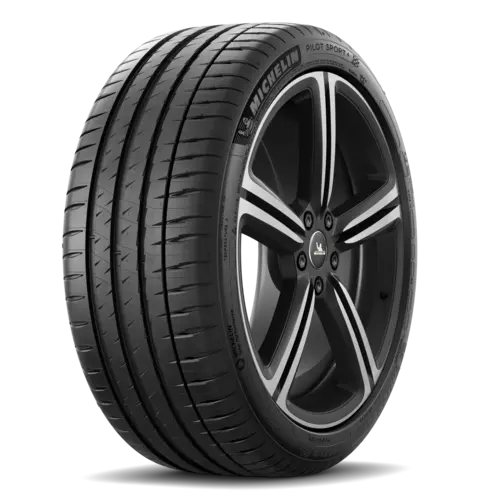
The Michelin Pilot Sport 4S earns the top position for most BMW performance drivers — it was developed in direct collaboration with BMW M using M3, M4, and M5 OEM fitment requirements as the engineering specification, and the Bi-Compound tread’s dual-zone performance is the specific design that Michelin’s BMW partnership page confirms as the reason this tire is star-marked for M Series models. BMW drivers who need year-round capability should choose the Continental ExtremeContact DWS06 Plus — xBimmers and r/BMWX3 members consistently document a night-and-day improvement in ride comfort over factory run-flats, and Tire Rack’s 965-plus buyer reviews average 9–10 for comfort across the BMW fitment sizes. Luxury-focused BMW owners who prioritize cabin quietness in premium SUV platforms should evaluate the Pirelli P Zero PZ4, which carries BMW star-marking for X5, X6, and X7 and uses PNCS acoustic foam to address the noise amplification that run-flat sidewall construction creates.
Our Top 6 BMW Tire Rankings
- Michelin Pilot Sport 4S— Best Overall / BMW M Series
- Continental ExtremeContact DWS06 Plus— Best All-Season / Daily Driver
- Pirelli P Zero PZ4— Best Premium / BMW SUV
- Goodyear Eagle F1 Asymmetric 2 ROF— Best Run-Flat Upgrade
- Bridgestone Potenza Sport— Best Wet Performance
- Michelin Pilot Sport All Season 4— Best Value All-Weather
Best BMW Tires — Compared
All six tires ranked across category, season, and our expert score.
| # | Tire Name | Season | BMW Star-Marked | Best For | Score | |
|---|---|---|---|---|---|---|
| 1 | Michelin Pilot Sport 4S Editor’s Choice | Summer | Yes (M Series) | Best Overall | 4.8 | See Latest Price |
| 2 | Continental ExtremeContact DWS06 Plus Top Pick | All-Season | — | Best All-Season | 4.7 | See Latest Price |
| 3 | Pirelli P Zero PZ4 | Summer | Yes (X5/X6/X7/M) | Best Premium SUV | 4.7 | See Latest Price |
| 4 | Goodyear Eagle F1 Asymmetric 2 ROF | Summer | — | Best Run-Flat | 4.5 | See Latest Price |
| 5 | Bridgestone Potenza Sport | Summer | — | Best Wet Braking | 4.6 | See Latest Price |
| 6 | Michelin Pilot Sport All Season 4 Budget Pick | All-Season | — | Best Value Year-Round | 4.5 | See Latest Price |
Detailed Reviews
Full breakdown of each tire — ratings, pros, cons, and our expert verdict.
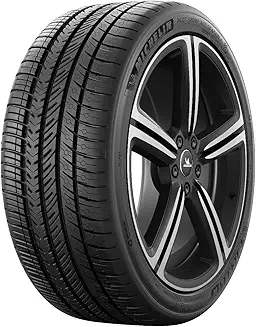
Michelin Pilot Sport 4S
Pros
- Bi-Compound tread with softer outer edge for cornering grip and harder inner edge for straight-line stability — the dual-zone engineering that Michelin’s BMW partnership documentation confirms as developed alongside BMW M’s suspension geometry, producing the precise steering feedback at speed that r/BMWM and YouTube reviewers consistently describe as preserving rather than diluting the M Series’ core dynamic character
- BMW star-marked for M5 Touring and Sedan alongside High Load Capacity (HL) variant for heavier xDrive models — the two specific BMW fitment details that distinguish this tire from non-starred performance alternatives, where the HL variant’s load rating matches the xDrive system’s weight distribution requirements that lighter-rated alternatives address inadequately
- Run-flat variant (4S RFT) available for M Series models requiring post-puncture mobility alongside strong hydroplaning resistance for a max-performance summer compound — the combination that makes this the correct recommendation for BMW M owners who cannot carry a spare and need the OEM dynamic character maintained even in the run-flat construction
Cons
- Summer-only — the compound loses grip significantly below 7°C (45°F) and becomes genuinely dangerous on winter roads, making this tire incompatible with BMW owners in Germany, Scandinavia, northern US, or Canada who drive their car year-round without a dedicated winter tire set swap on separate wheels
- Firmer ride feel especially in run-flat form — the reinforced sidewall construction that provides post-puncture mobility amplifies road surface imperfections in a way that multiple YouTube reviewers and r/BMW members document as noticeably firmer than non-run-flat alternatives on the same BMW platform
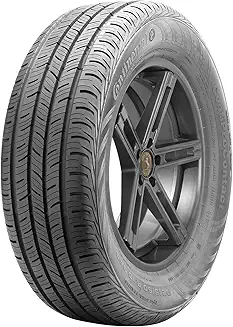
Continental ExtremeContact DWS06 Plus
Pros
- Tire Rack’s 965-plus buyer reviews average 9–10 for comfort and 9–10 for noise across BMW fitment sizes — the most extensively reviewed BMW all-season tire in this comparison, and the specific validation that makes xBimmers and r/BMWX3 members’ night-and-day ride comfort improvement reports over factory run-flats credible rather than anecdotal
- SportPlus Technology for dry handling precision alongside Traction Grooves for wet and snow performance — the dual-season engineering that makes this the correct year-round recommendation for BMW X3 and 5 Series owners in four-season climates who cannot or will not maintain a separate winter tire set on dedicated wheels
- DWS (Dry/Wet/Snow) tread wear indicators showing degraded season capability as the tire wears — the specific safety feature that addresses the BMW run-flat owner’s challenge: factory run-flats show no visual wear warning when their cold-weather performance has degraded, while the DWS indicators provide a visible signal that remaining tread depth corresponds to reduced season capability
Cons
- Tread life can disappoint under hard cornering on rear-drive BMW M models — g30.bimmerpost members document faster rear wear on M Sport and M Series BMWs where the power application and cornering loads exceed what the all-season compound’s durability was designed to sustain, making this tire less appropriate for owners who drive their BMW at the performance end of its capability regularly
- Snow traction is capable but limited in true winter conditions — the DWS compound’s all-season character provides adequate grip in moderate cold and light snow but becomes marginal in genuine Alpine or northern winter conditions where a dedicated winter tire set on separate wheels would provide safety margins that the DWS06 Plus cannot match
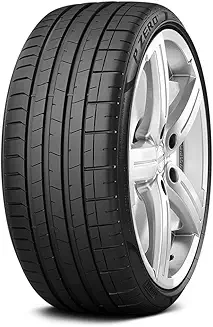
Pirelli P Zero PZ4
Pros
- PNCS (Pirelli Noise Cancelling System) polyurethane foam liner reducing interior cabin noise — the specific acoustic technology that r/tires members cite as making the P Zero PZ4 noticeably quieter than other performance tires in the same category, addressing the run-flat sidewall amplification effect that makes factory BMW run-flats louder than equivalent non-run-flat alternatives on the same platform
- BMW star-marked and OEM-approved for X5, X6, X7, and M Series alongside run-flat variant (PZ4L) for BMW models without spare tire storage — the OEM validation that confirms this tire is tuned to BMW’s specific suspension geometry and load requirements rather than being a generic premium tire adapted to BMW sizes
- Advanced silica-carbon black compound delivering strong wet and dry grip confirmed by YouTube independent reviews — the compound performance that BlackCircles.com review aggregation documents as producing smooth refined ride quality suited to the BMW X-family’s luxury positioning rather than the compromised ride character that pure performance compounds create on heavy SUV platforms
Cons
- Run-flat variant (PZ4L) receives mixed reviews from BMW X3 owners — x3.xBimmers members specifically document a stiff ride on the PZ4L that limits its comfort advantage over factory run-flats, suggesting the PNCS acoustic benefit is more pronounced in the standard non-run-flat version than in the PZ4L run-flat construction where sidewall stiffness partially offsets the foam liner’s acoustic improvement
- Tread life on high-power rear-drive M Series BMWs trends toward the shorter end — the performance compound’s grip priority creating a durability trade-off that matters more for M3 and M4 owners who use the rear-drive platform’s performance capability actively than for X5 and X7 owners where AWD distribution reduces single-axle compound stress
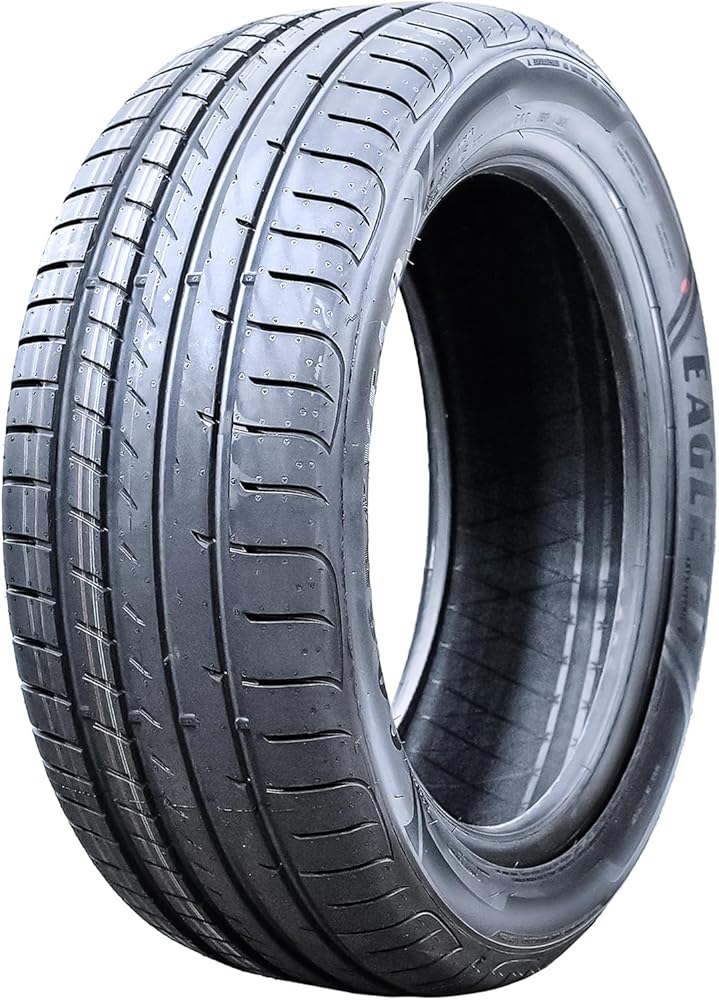
Goodyear Eagle F1 Asymmetric 2 ROF
Pros
- RunOnFlat technology providing 80 km of mobility after puncture at max 80 km/h — the post-puncture safety specification that BMW run-flat owners require, and that TyreReviews’ 365-plus user reviews confirm functions as specified, making this the correct run-flat upgrade recommendation for BMW owners who need to maintain the run-flat safety function that most BMW models without spare tire wells depend on
- Noticeably quieter and more comfortable than OEM Bridgestone run-flats documented by TyreReviews members — the specific acoustic and comfort improvement that makes this a meaningful upgrade over factory fitments rather than a lateral replacement, and that the ActiveBraking Technology’s shorter stopping distances deliver alongside the comfort benefit
- Available across BMW 3, 5, 7, X1, and X3 run-flat sizes — the broad BMW platform coverage that makes this the most practical run-flat upgrade recommendation for BMW owners across multiple model lines without requiring size-specific sourcing from a limited availability pool
Cons
- Some run-flat variants develop sidewall bulging on rough road surfaces — TyreReviews documents this pattern across multiple reviews, representing a structural concern that is more likely on run-flat construction generally than on conventional tires, and that BMW owners who drive on particularly poor road surfaces should monitor during routine inspection
- Performance drop noticeable as tread wears toward the wear indicators — TyreReviews specifically documents this pattern, where the Eagle F1 Asymmetric 2 ROF’s wet and dry performance metrics decline more steeply than premium alternatives in the final third of tread life, making timely replacement more important than on tires with more linear wear characteristics
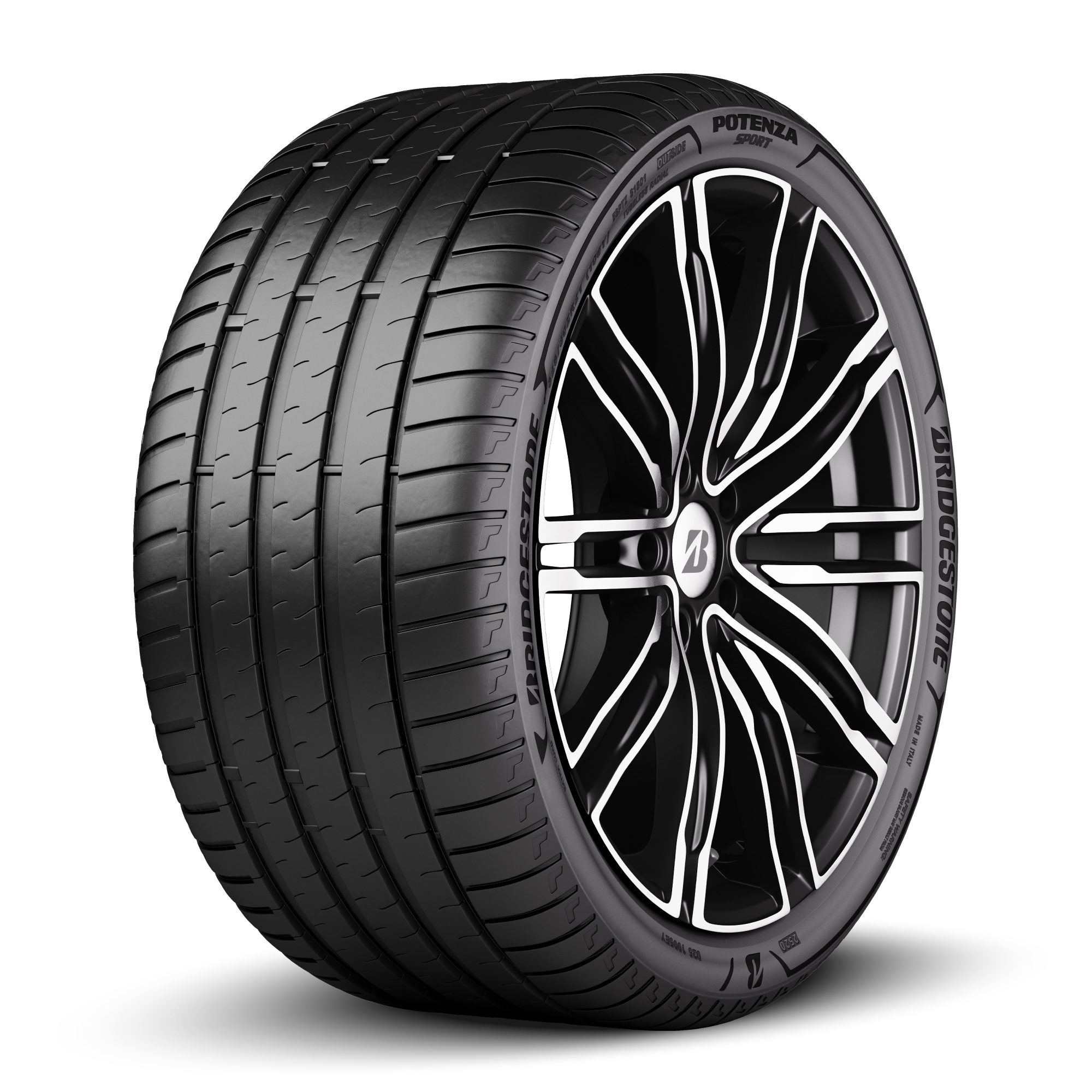
Bridgestone Potenza Sport
Pros
- Winner of evo magazine’s 2025 tyre test conducted on a BMW 135i xDrive with the shortest wet braking distance and top dry lap time — the most specific external validation in this comparison, where the test vehicle being a BMW rather than a generic test car makes the performance data directly applicable to BMW 1, 3, and 4 Series owners evaluating this tire
- EU label A-grade wet grip across the full lineup alongside TÜV SÜD independent confirmation of best-in-class wet cornering, handling, and straight-line stability — the dual independent validation from both EU labeling testing and TÜV SÜD standardized assessment that makes the wet performance claim credible rather than manufacturer marketing
- Sharp, communicative steering response confirmed by Tire Rack buyer reviews and TyreReviews — the specific steering character that BMW 3 and 4 Series owners who chose this platform for its dynamic character will recognize as complementing rather than blunting the car’s inherent feedback, making this the correct performance recommendation for drivers who value what they feel through the steering wheel
Cons
- Road noise at highway speeds is a recurring TyreReviews complaint — the tread pattern’s performance-optimized void ratio that produces the wet braking advantage simultaneously generates highway noise that becomes fatiguing on longer motorway trips, making this tire a less appropriate recommendation for BMW owners whose primary use is long-distance autobahn or motorway driving rather than spirited road driving
- Tread wear varies significantly with driving style — Tire Rack documents this pattern, where BMW 3 and 4 Series owners who use the performance compound’s grip capability actively wear through the compound faster than conservative drivers on the same tire, creating very different tread life experiences that make per-mile cost calculations difficult to predict for aggressive drivers
Michelin Pilot Sport All Season 4
Pros
- Over 1,658 verified buyer reviews on Discount Tire’s BMW fitment page making it the most-reviewed BMW tire on that platform — the review volume that provides the most statistically reliable consumer sentiment data in this comparison, reducing the risk that individual outlier reviews misrepresent the tire’s true performance profile across diverse BMW owners and driving conditions
- Helio+ compound providing cold-temperature traction below 7°C alongside variable contact patch for wet and dry grip — the all-season engineering that addresses the specific failure mode of summer-only alternatives on autumn and early spring roads where temperatures drop near freezing on wet surfaces before they drop to snow levels
- Year-round capability for BMW 3 and 5 Series owners who want M-car handling character without committing to summer-only rubber — the lowest-priced tier in this comparison while carrying Michelin’s Pilot Sport DNA, providing the most practical cost argument for BMW daily drivers who want premium handling without the seasonal complexity and dual wheel set cost that summer tire use in four-season climates requires
Cons
- Not sufficient for dedicated winter or snow conditions — the Helio+ compound’s cold-temperature improvement addresses the 7°C to 0°C range adequately but becomes insufficient below freezing in sustained snow or ice conditions, making this tire incompatible with BMW owners in Germany’s Black Forest, Bavaria, or Scandinavian climates where genuine winter conditions require a dedicated winter tire set
- Less grip than summer-only alternatives in warm weather months — the compound’s cold-temperature flexibility that produces the year-round advantage simultaneously reduces the maximum warm-weather grip that the Pilot Sport 4S achieves, creating a performance gap that BMW M owners who specifically purchased their car for summer driving dynamics will find frustrating on track days or canyon roads
???? Can’t Decide?
Our Top 2 Picks — Head to Head
Both are excellent. Here’s how to choose between them.
- Developed in direct collaboration with BMW M using M3, M4, and M5 OEM fitment requirements as the engineering specification — the most specific BMW validation in this comparison, where the tire’s Bi-Compound tread geometry was designed around BMW M’s suspension rather than adapted to it
- BMW star-marked for M5 Touring and Sedan alongside HL variant for heavy xDrive models — the two OEM fitment credentials that the Continental DWS06 Plus cannot claim, confirming this tire is tuned to BMW specifications rather than being a general-market tire available in BMW sizes
- Razor-sharp steering feedback and confidence-inspiring cornering confirmed by r/BMWM and YouTube reviewers — the dynamic character that BMW M owners specifically purchased their car to experience, and that no all-season alternative can fully replicate in warm-weather conditions regardless of brand
- Night-and-day comfort improvement over factory run-flats documented by xBimmers and r/BMWX3 members — the real-world ride quality upgrade that matters for BMW X3 and 5 Series daily commuters who experience factory run-flat harshness every weekday morning
- Tire Rack’s 965-plus buyer reviews averaging 9–10 for comfort and noise across BMW fitments — the largest verified review base for a BMW all-season in this comparison, providing the most statistically reliable performance data across diverse owner conditions
- DWS wear indicators showing degraded season capability as tread wears — the specific feature that addresses the BMW run-flat owner’s challenge of knowing when their all-season performance has degraded below a useful threshold without external visual warning
How to Choose the Right Tires for Your BMW
Six BMW-specific factors that change the tire selection calculus versus generic luxury cars.
The BMW Star-Marking System
BMW star-marked (*) tires from Michelin and Pirelli are tuned to BMW’s specific suspension geometry and noise requirements — they differ measurably from non-marked versions of the same tire model. xBimmers members document handling and acoustic differences between starred and non-starred variants of the same tire family. When buying OEM-equivalent replacement tires, always verify the star-marking rather than assuming all variants of a tire brand perform identically on BMW.
Run-Flat vs. Conventional Decision
Most BMW models from 2010 onward have no spare tire and require run-flat construction for post-puncture mobility. Switching to conventional tires is mechanically safe but requires purchasing a tire mobility kit and understanding you need roadside assistance after any puncture. r/BMWX3 members who make this switch document better ride quality but document the emergency planning requirement as the key consideration before doing so.
Season Matching for Your Climate
BMW’s summer performance tires lose grip significantly below 7°C (45°F) and become genuinely dangerous in winter conditions. BMW drivers in Germany, Scandinavia, northern US, or Canada need either all-season tires or a dedicated winter set on separate wheels — the cost of a dual wheel set is lower than the consequence of summer tires on winter roads. Drivers in California, Texas, or Mediterranean Europe can comfortably run summer tires year-round.
xDrive vs. Rear-Drive Wear Patterns
Rear-drive BMW M Series drivers wear through rear tires two to three times faster than all-wheel-drive X3 owners on identical compounds. A tire review from an X3 owner and a review from an M3 owner describe completely different tread life experiences on the same tire. Factor your specific BMW’s drive configuration into tread life expectations — g30.bimmerpost members document this difference specifically for the 5 Series G30 platform across drive configurations.
Match OEM Size Exactly
BMW’s stability control, xDrive torque distribution, and speedometer calibration all depend on correct tire diameter. Even a small size mismatch stresses the xDrive differential on AWD models and triggers DSC errors. Check your door jamb sticker or owner’s manual for the approved fitment — never assume from forum recommendations or another BMW owner’s setup, since sizes vary across model years and equipment options on the same model line.
Replace in Pairs — Never One at a Time
BMW advises against mixing tires of different tread depths, especially on xDrive AWD models where circumference differences above 2–3mm strain the AWD differential system. At minimum, replace matching pairs on the same axle. Full set replacement is strongly preferred when tread depth difference across positions exceeds 3mm. xBimmers specifically documents AWD differential stress cases attributed to mismatched tire wear across axles on X3 and X5 platforms.
✅ Pro Tips
Quick Buying Checklist Before You Order
Always verify the BMW star-marking (*) on Michelin and Pirelli variants before ordering — non-starred versions of the same tire model perform differently on BMW’s suspension geometry, and the cost difference between starred and non-starred variants is smaller than the handling difference they produce.
Never run summer tires below 7°C (45°F) — the compound hardens and loses grip in ways that overwhelm even BMW’s sophisticated stability control systems. If your region sees these temperatures regularly, commit to all-season tires or a dedicated winter set before the first autumn cold snap.
Match your OEM size from the door jamb sticker, not from another BMW owner’s recommendation. Sizes vary across model years and option packages on the same model line, and a size mismatch triggers DSC errors and stresses xDrive differentials on AWD platforms.
If switching from run-flat to conventional tires, buy a quality 12V tire inflator and a plug kit before you drive on the new setup — most BMW models have no spare tire well, and a conventional tire flat requires roadside assistance unless you carry inflation and repair equipment.
Related Guides
Popular BMW Tire Guides
Browse by series — each guide covers every trim and year range.
Also On CarAssists
More Guides for This Vehicle
Frequently Asked Questions
What are the best tires for BMW 3 Series?
The Michelin Pilot Sport 4S is the top summer pick for the 3 Series, developed in direct collaboration with BMW M and star-marked for M Series fitments. For year-round use in four-season climates, the Continental ExtremeContact DWS06 Plus or Michelin Pilot Sport All Season 4 both offer excellent all-season balance with strong wet performance and longer tread life than summer-only alternatives.
Which tires are best for BMW X5?
The Pirelli P Zero PZ4 carries a BMW star-marking for the X5 and uses PNCS acoustic foam to reduce the cabin noise that run-flat sidewall construction amplifies on BMW SUV platforms. The Michelin Pilot Sport All Season 4 is a solid alternative for X5 drivers who prioritize year-round capability over the BMW star-marked fitment’s OEM acoustic matching.
How long do performance BMW tires typically last?
Summer performance tires on BMW M models typically last 20,000 to 30,000 miles depending on driving aggression and rotation frequency — rear-drive M Series owners wear through rears two to three times faster than AWD X3 owners on identical compounds. All-season tires like the Continental DWS06 Plus tend to last 40,000 to 50,000 miles under normal driving conditions documented by g30.bimmerpost members.
Can I replace BMW run-flat tires with standard tires?
Yes, most BMW models can use standard tires after a run-flat swap. You need a tire inflation kit or portable air compressor for roadside emergencies since most BMWs have no spare tire well. r/BMWX3 members who make this switch document noticeably better ride comfort, but confirm the emergency planning requirement as the key practical consideration before doing so.
What does the BMW star-marking on Michelin and Pirelli tires mean?
The BMW star mark (*) means the tire was specifically tuned to BMW’s suspension geometry, noise requirements, and load characteristics rather than being a generic tire adapted to BMW sizes. Michelin and Pirelli produce starred variants that differ measurably from non-starred versions of the same tire model. xBimmers members document handling and acoustic differences between starred and non-starred variants on the same BMW platform.
Are Michelin or Pirelli better for BMW?
Both produce BMW star-marked tires with strong performance credentials tuned to BMW’s specific requirements. Michelin’s Pilot Sport 4S leads in outright dry grip and steering response from development in direct collaboration with BMW M. Pirelli’s P Zero PZ4 edges ahead in cabin noise reduction through PNCS foam technology. The choice depends on whether performance or cabin quietness ranks higher in your ownership priorities.
Do aftermarket tires affect BMW’s stability control and xDrive systems?
Correctly sized aftermarket tires with the appropriate load and speed rating do not affect BMW’s DSC stability control or xDrive AWD system. The risk arises from size mismatches — circumference differences above 2 to 3mm across axles strain the xDrive differential and create DSC calibration errors. Always match the OEM size specification from your door jamb sticker and replace in matched pairs at minimum, never one tire at a time.
???? Final Verdict
Our Top BMW Tire Recommendations for 2026
The Michelin Pilot Sport 4S earns the top position for BMW M Series and performance drivers — its development in direct collaboration with BMW M using M3, M4, and M5 OEM fitment requirements as the engineering specification, Bi-Compound tread’s dual-zone performance, and BMW star-marking for M Series and HL variant for xDrive models make it the most validated performance recommendation in this comparison. BMW drivers who need year-round capability should choose the Continental ExtremeContact DWS06 Plus — xBimmers and r/BMWX3’s documented night-and-day comfort improvement over factory run-flats alongside 965-plus Tire Rack buyer reviews averaging 9–10 for comfort make it the most reliable all-season upgrade recommendation. Luxury-focused BMW SUV owners who prioritize cabin quietness should evaluate the Pirelli P Zero PZ4, which carries BMW star-marking for X5, X6, and X7 with PNCS acoustic foam addressing the noise amplification that run-flat sidewall construction creates.